
State of the Science of Salinity Risks in the Chesapeake Bay and Its Tributaries: Connecting Monitoring, Modeling and Management
May 26, 2026 - May 27, 2026Shepherdstown, WV
This workshop convened in-person on Tuesday-Wednesday, May 26-27, 2026 at the National Conservation Training Center (NCTC) in Shepherdstown, WV.
- Workshop Participants (as of May 19th)
Photo (taken on Day 1) of in-person participants at the Salinity Risks workshop.
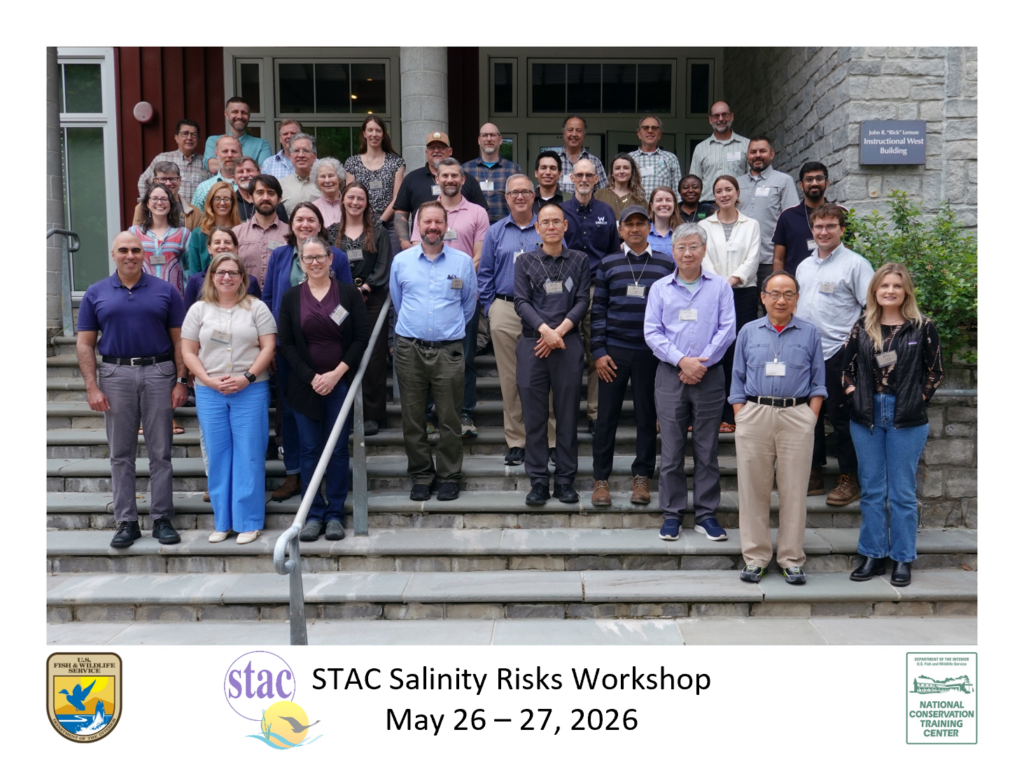
The Scientific and Technical Advisory Committee (STAC) hosted a workshop to assess the state of the science of salinization in the Chesapeake Bay watershed, gain a better understanding of long-term trends and the magnitude and frequency of extreme salinity events, and identify effective ways to anticipate and manage changes in salinization. The workshop will result in a comprehensive document that describes the state of the science of salinization risks in the Chesapeake Bay watershed and guidance for monitoring, modeling, and management from headwaters to coastal waters.
Workshop Agenda: Public_Workshop_Agenda_Salinity Risks_May 25
Presenter-shared resources
Workshop presenters have shared optional background articles and resources for participants. These materials are organized by session and are intended to provide additional context before and after the workshop.
Session I: Salinity Trends & Pulses in the Watershed
- Stanley Grant (VT)
- Rosemary Fanelli (USGS)
- Predictive Modeling Reveals Elevated Conductivity Relative to Background Levels in Freshwater Tributaries within the Chesapeake Bay Watershed, USA
- Regional high‑frequency monitoring revealed chloride concentrations in exceedance of ecological benchmarks in urban streams across the Delaware River Basin, USA
Session II: Salt Water Intrusion & Estuarine/Tidal Risks
- Greg Noe (USGS)
- Trends in vegetation and height of the topographic surface in a tidal freshwater swamp experiencing rooting zone saltwater intrusion
- Tidal Forested Wetlands Can Be Incorporated into Blue Carbon Conservation and Restoration Strategies
- The Effects of Varying Salinity on Ammonium Exchange in Estuarine Sediments of the Parker River, Massachusetts
- The effect of increasing salinity and forest mortality on soil nitrogen and phosphorus mineralization in tidal freshwater forested wetlands
- Soil Salinity and Water Level Interact to Generate Tipping Points in Low Salinity Tidal Wetlands Responding to Climate Change
- Small gradients in salinity have large effects on stand water use in freshwater wetland forests
- Saltwater Intrusion Modifies Microbial Community Structure and Decreases Denitrification in Tidal Freshwater Marshes
- Saltwater intrusion into tidal freshwater marshes alters the biogeochemical processing of organic carbon
- Salinity thresholds for understory plants in coastal wetlands
- Ramifications of increased salinity in tidal freshwater sediments- Geochemistry and microbial pathways of organic matter mineralization
- Periodicity in Stem Growth and Litterfall in Tidal Freshwater Forested Wetlands- Influence of Salinity and Drought on Nitrogen Recycling
- Patterns of Denitrification Potential in Tidal Freshwater Forested Wetlands
- Over, Under, and Through- Hydrologic Connectivity and the Future of Coastal Landscape Salinization
- Differences in impacts of Hurricane Sandy on freshwater swamps onthe Delmarva Peninsula, Mid-Atlantic Coast, USA
- Changes in suspended sediment concentration along tidal rivers of the Chesapeake Bay- the tidal freshwater “sediment shadow”
- Causal mechanisms of soil organic matter decomposition- deconstructing salinity and flooding impacts in coastal wetlands
- A global perspective on wetland salinization- ecological consequences of a growing threat to freshwater wetlands
- Watershed and Estuarine Controls Both Influence Plant Community and Tree Growth Changes in Tidal Freshwater Forested Wetlands along Two U.S. Mid-Atlantic Rivers
- Raymond Najjar (PSU): Identification and Characterization of Surface Water Intakes on the Chesapeake Bay
- Y. Joseph Zhang (VIMS)
- Machine learning prediction of saltwater intrusion to support coastal water resource management
- Assessment of salinity intrusion in the James and Chickahominy Rivers as a result of simulated sea-level rise in Chesapeake Bay, East Coast, USA
- A 3D unstructured-grid model for Chesapeake Bay- Importance of bathymetry
- Holly Michael (UDEL)
- The hidden influence of terrestrial groundwater on salt marsh function and resilience
- Terrestrial Groundwater Drives Coastal Ecosystem Shifts
- Surface Water-Groundwater Connections as Pathways for Inland Salinization of Coastal Aquifers
- Marsh Migration Into Forests and Farms- Effects on Soil Biogeochemistry Along the Salinity Gradients
- Groundwater and soil moisture data collected in the coastal critical zone of the Delmarva Peninsula, United States
- Effects of Marsh Migration on Flooding, Saltwater Intrusion, and Crop Yield in Coastal Agricultural Land Subject to Storm Surge Inundation
- Drivers of barrier island water-table fluctuations and groundwater salinization
- Beyond the Wedge- Impact of Tidal Streams on Salinization of Groundwater in a Coastal Aquifer Stressed by Pumping and Sea‐Level Rise
Session III: Food, Water, Infrastructure
- Kate Tully (UMD)
- Coastal stressors reduce crop yields and alter soil nutrient dynamics in low-elevation farmlands
- Effects of saltwater intrusion on candidate restoration species in coastal agricultural fields
- Farming carbon- The link between saltwater intrusion and carbon storage in coastal agricultural fields
- Management strategies for reducing phosphorus levels in saltwater-intruded agricultural fields
- The Invisible Flood- The Chemistry, Ecology, and Social Implications of Coastal Saltwater Intrusion
- Rebecca Murphy (NVRC): Virginia Salt Management Strategy Toolkit
Session IV: Management Strategies & Freshwater Salinization Syndrome
- Jason Dubow (Maryland Dept of Planning): Maryland’s Plan to Adapt to Saltwater Intrusion and Salinization
- Pinki Mondal (UDEL)
- Fluctuating soil salinity across natural and managed landscapes of the coastal mid-Atlantic facing rapid sea-level rise
- Non-linear spectral unmixing for monitoring rapidly salinizing coastal landscapes
- The spread and cost of saltwater intrusion in the US Mid-Atlantic
- A global review of the impacts of saltwater intrusion on soils and ecosystems
- link to Project WICCED – An Investigation of Saltwater Intrusion in the Complex Coastal Environment of Delaware
- Link to RISING Mid-Atlantic – Community-driven solutions for salt-impacted coastal lands
- link to RISCC Project – Risks, Impacts, & Strategies for Coastal Communities
- Adam Bosch (NYC DEP): Salinity Trends in the New York City Watersheds
- Rabia Chaudhry (DC Water): DC Water’s Strategy to Improve Water Supply Resilience
- Camryn Arnstein (MDE)
- Abby Hileman (IWLA)
- Lauren McPhillips (PSU): Impacts of Deicer Salt on Water Quality Performance of Stormwater Bioretention Systems with Varied Vegetation and Hydrology
Workshop Steering Committee:
* STAC Member
- Sujay Kaushal, UMD, Co-Chair
- Stanley Grant, VT, Co-Chair
- Steven Bieber, MWCOG
- Caitlin Bolton, MWCOG
- Rosemary Fanelli, USGS
- KC Filipino*, HRPDC
- Kaylyn Gootman, EPA
- Conor Keitzer, UMCES
- Lew Linker, EPA
- Paul Mayer, EPA
- Steven Nelson, WSSC
- Greg Noe*, USGS
- Lisa Ragain, MWCOG
- Megan Rippy, VT
- Peter Tango, USGS
Presentations:
Session I: Salinity Trends & Pulses in the Watershed
- Trends, Effects, and Chemical Aspects of Increasing Salinity – Sujay Kaushal (UMD)
- Impacts of Increasing Salinity Sources on Drinking Water – Stanley Grant (VT)
- Chesapeake Bay Watershed Trends in Salinity – Rosemary Fanelli (USGS)
- Effect of Urban-Related Increases in Salinity on Freshwater Macroinvertebrates and Fish Degrades Ability to Detect Changes in Stream Health – Matt Baker (UMBC)
- Aquatic Chemistry, Nutrient Effects of Salinization in Estuarine Waters – Steve Goldsmith (Villanova)
- Characterizing the Social-Ecological System for Inland Freshwater Salinization: Implications for Collective Management – Megan Rippy (VT)
Session II: Salt Water Intrusion & Estuarine/Tidal Risks
- Advancing Phosphorus Modeling: Integrating pH and Salinity Predictors in Chesapeake Bay Watershed Modeling – Conor Keitzer (UMCES), Joseph Delesantro (KGS-EPA)
- Saltwater Intrusion Impacts on Coastal Landscapes – Greg Noe (USGS)
- Identification and Characterization of Surface Water Intakes on the Chesapeake Bay – Raymond Najjar (PSU)
- Estimating Salt Water Intrusion in the Chesapeake under SLR – Y. Joseph Zhang (VIMS)
- Mechanisms of salinization of coastal water resources and ecosystems: Insights from observations across the Mid-Atlantic – Holly Michael (UDEL)
- Ghost Forests as Indicators of Salinity Change – Rebecca Epanchin-Niell (UMD)
Session III: Food, Water, Infrastructure
- Saltwater Intrusion Impacts on Agriculture – Kate Tully (UMD)
- Drinking Water Impacts:
- Delaware River Basin Region – Amy Shallcross (Delaware River Basin Commission)
- DC Region – Lisa Ragain (MWCOG)
- Northern Virginia – Rebecca Murphy (NVRC)
Session IV: Management Strategies & Freshwater Salinization Syndrome
- Policies and Priority Research Needs for Managing Saltwater Intrusion Risks in Maryland – Jason Dubow (Maryland Dept of Planning)
- Agricultural Economic Losses from Salinization – Pinki Mondal (UDEL)
- Drinking Water Management in Major Cities
- Philadelphia – Molly Hesson (Philadelphia Water)
- New York City – Adam Bosch (NYC DEP)
- District of Columbia – Rabia Chaudhry (DC Water)
- Water Management in Counties
- Anne Arundel County, MD – James Howard (AA County DPW)
- Hampton Roads, VA – KC Filippino (HRPDC)
- MDE Smart Salting Training Program in Maryland – Camryn Arnstein (MDE)
- Fairfax County Chloride TMDL and Salt Management Strategy (SAMS) – Martin Hurd (Fairfax County, VA)
- Izaak Walton League of America’s Salt Watch Monitoring – Abby Hileman (IWLA)
- Managing Salt – A Utility’s Perspective – Robin Forte (WSSC Water)
- Road Salt Transport Through Stormwater Basins and Its Effect on Metals and Water Quality – Lauren McPhillips (Penn State)
If you have any questions, please contact Meg Cole, STAC Coordinator, at colem@chesapeake.org.